Design Graphics 1
Drafting and Drawing of the Built Environment
Students learn introductory drafting, lettering, and drawing techniques as they relate to the field of Landscape Architecture and professional standards. All work product is developed from Tongva Park, a real site located in Santa Monica. The final submission drawing represents the following deliverables:
1. Original vellum, 18″ x 24″, original pencil, hand drafting and drawing. No cut and paste except for photo gallery.
2. Use of Tongva Park base plans to extract the plan information represented in the Layout Plan Legend.
3. Introductory understanding of:
- Use of drafting tools
- Scale (Architect and Engineer Scales) and scale manipulation
- Line Weights (For the Layout Plan, Pedestrian Circulation being weighted with priority)
- Topography and Contours
- Principles of Plan and Section Graphics
- Develop Section, Section/Elevation from topography and plan information from Tongva Park base plans.
- Introductory proportionally scaled 1 and 2 point perspective sketching by hand
- Visualization and creation of 3-dimensional space through the use of 1 and 2 point perspective drawing, 2 dimension plan projection and graphing of topography, section/elevation.
- Photography of section line and perspective sketching for reference on presentation sheet
- Graphic formatting of presentation sheet
- Scanning specifications and printing of drawing sheets
- Digital file development and on-line organization
- Communication and introductory use of, ‘language of landscape architects’
- Hand lettering
Instructor
DAVID SQUIRES
Project Location
TONGVA PARK SANTA MONICA/CA
judges
DANTE INIGUEZ – TERREMOTO
TRICIA O’CONNELL – ECOCENTRIX LANDSCAPE ARCHITECTURE | SANCTUARY LANDSCAPE ARCHITECTURE | TERRA SOMA LANDSCAPE ARCHITECTURE
SCRIBES
CARL DEO
MARIO CALITO
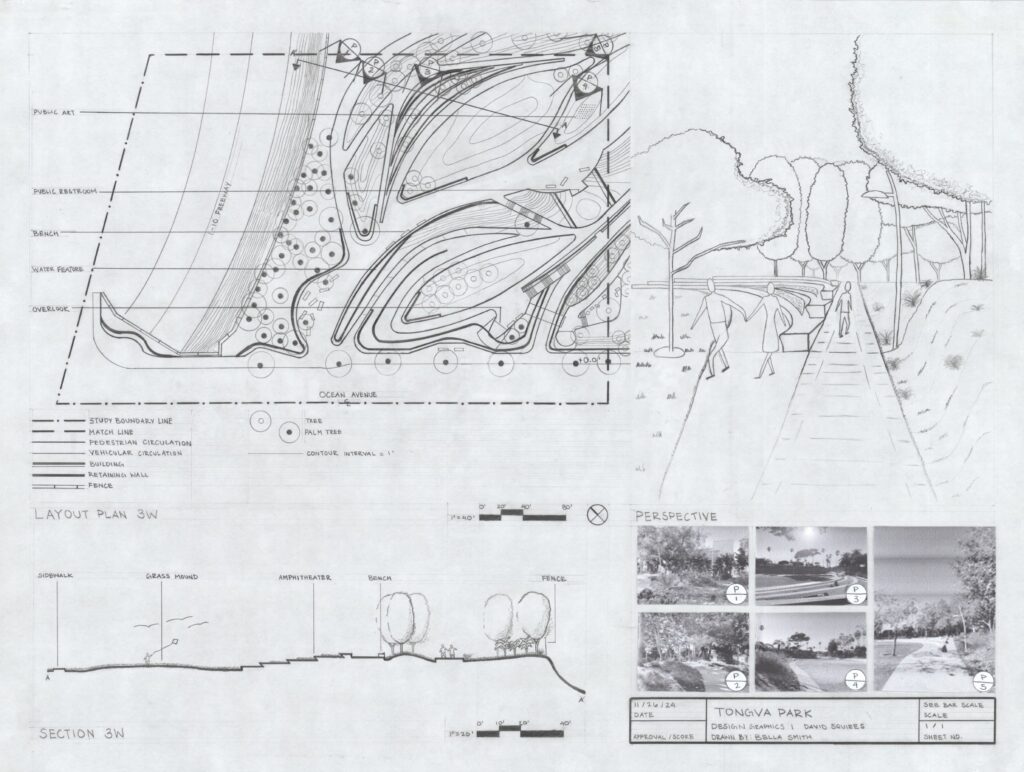
Tongva Park: Quadrant 3W
Student: Bella Smith
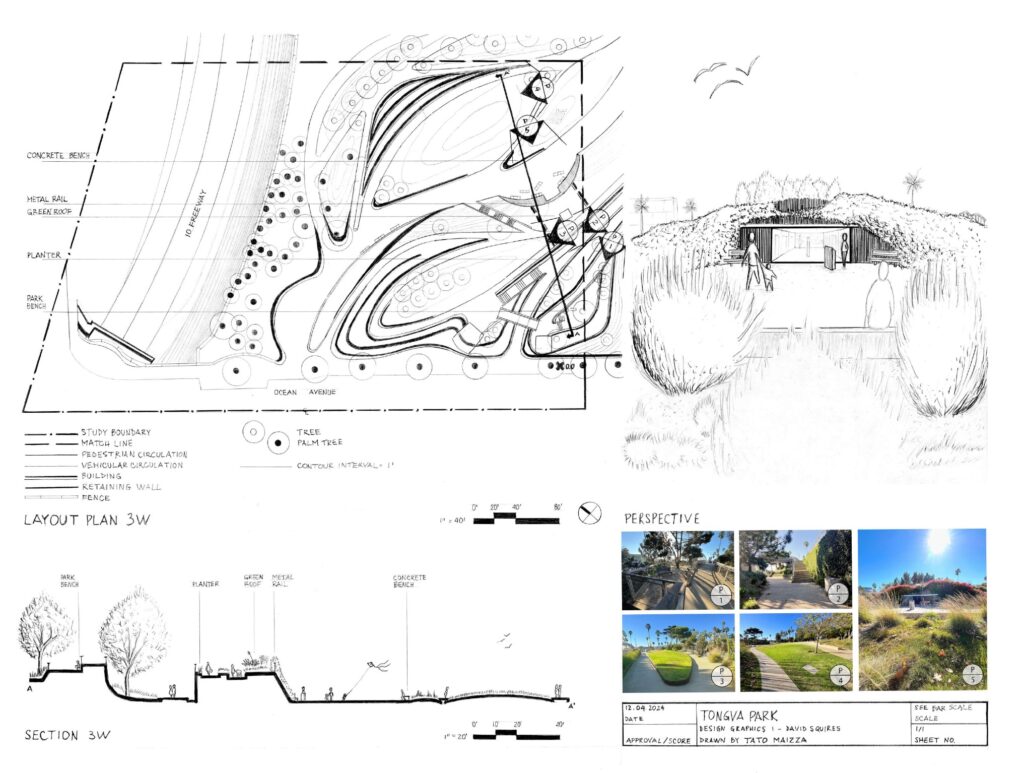
As the first stepping stone into hand drafting, DG1 uses Santa Monica’s Tongva Park as a bridge to teach new students the importance and technical skills of hand drafting.
View PDF
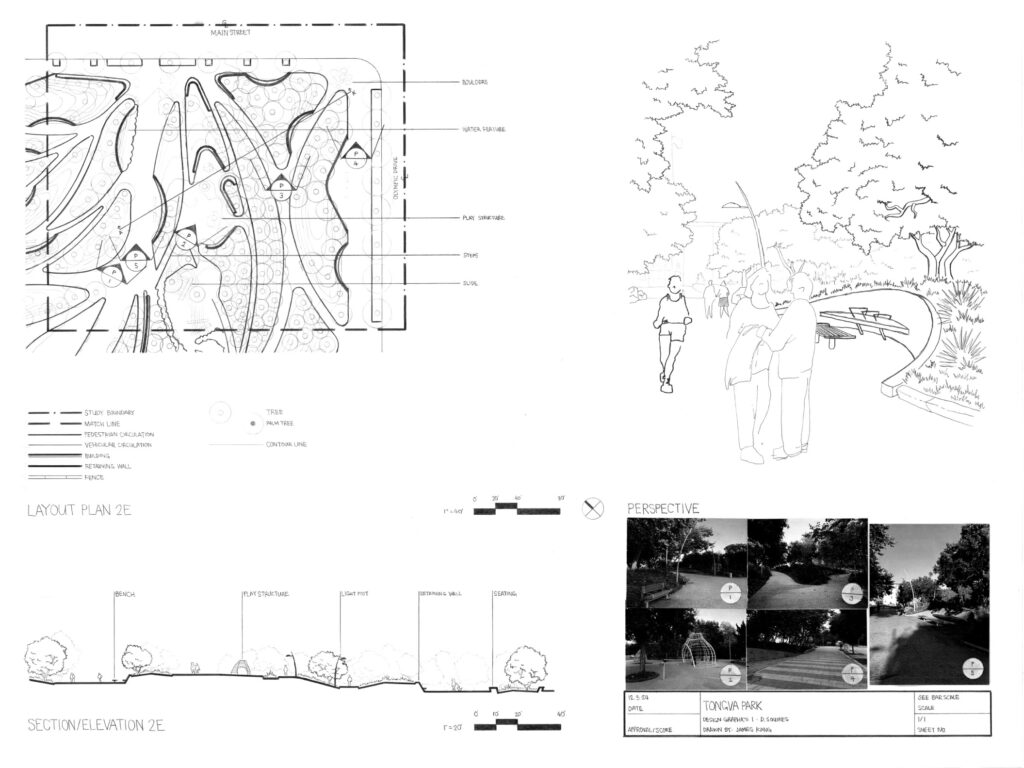
Tongva Park: Quadrant 2E
Student: James Kang
Hand drafting of a dimensioned site plan, section/elevations and perspective sketch
View PDF

SCASLA Honorable Mention
The judges praised the illustrative plan as clean, with good line weights and well-executed text. The section drawing was described as nice overall. In the perspective, the wall texture was appreciated.
Tongva Park: Quadrant 2E
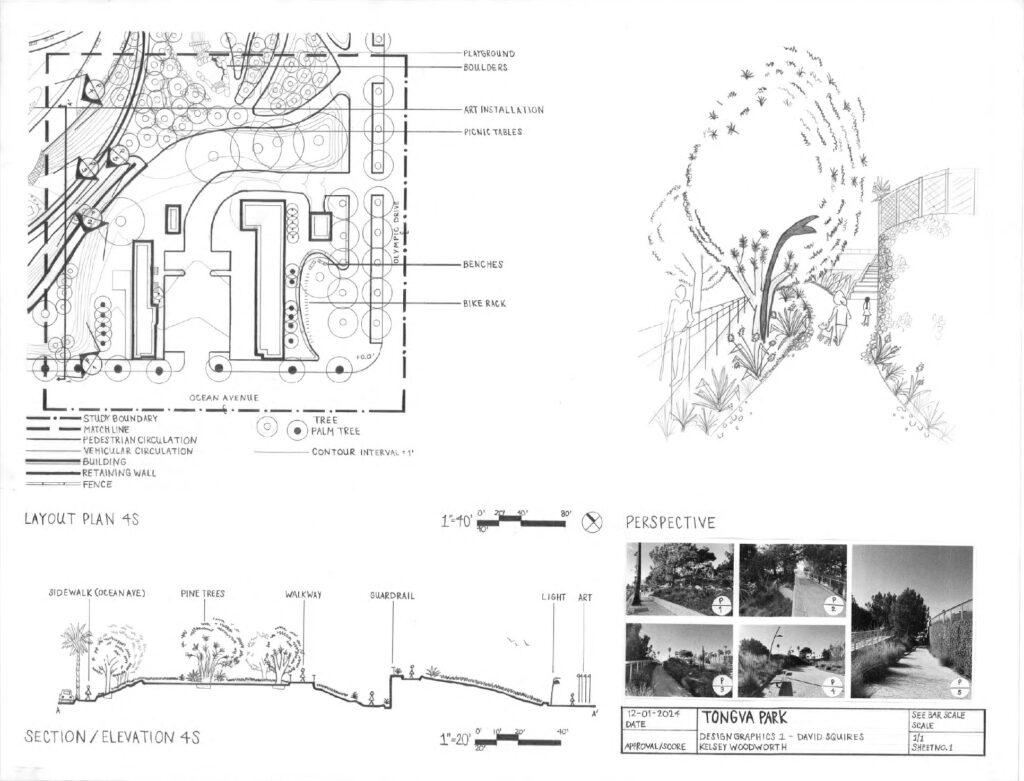
Student: Kelsey Woodworth
Hardscape drawings of Tongva Park
View PDF

SCASLA Excellence Award
The judges praised the illustrative work for its good layout, strong line hierarchy, and clear callouts. In the perspective drawing, they highlighted the successful use of plant textures and figures, which created a lively and convincing scene.
Tongva Park: Quadrant 4S
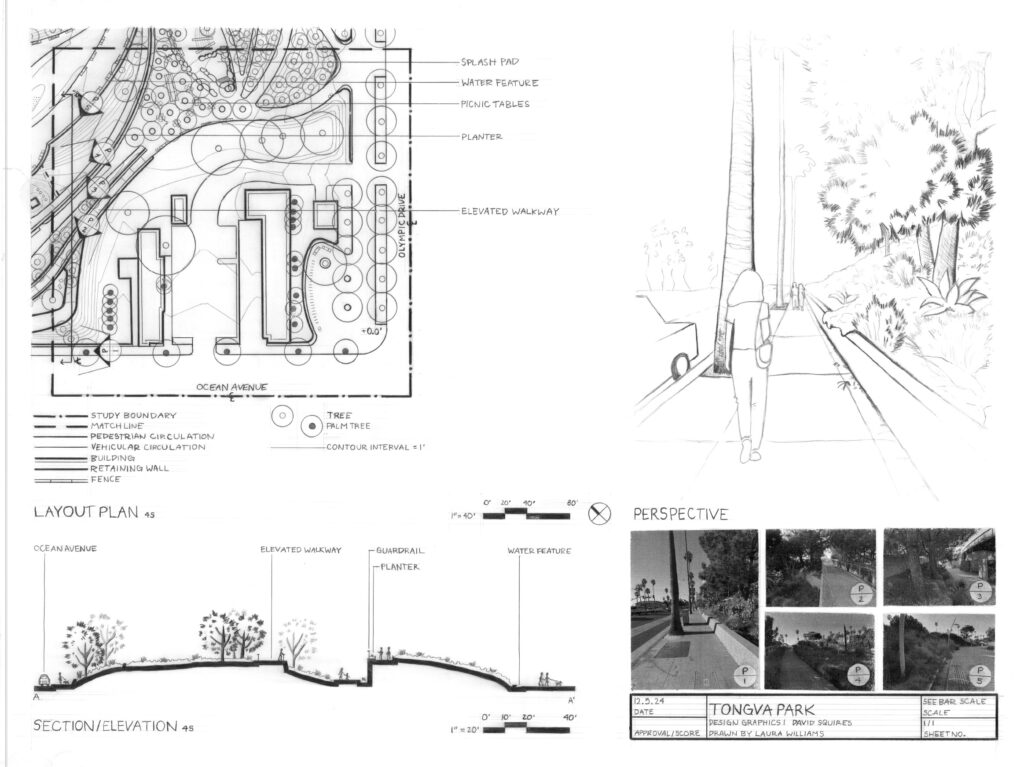
Student: Laura Williams
This project explores the southwest quadrant of Tongva Park in plan, section, perspective, and photos. This was the final project for a class that was an introduction to landscape architecture design graphics. All drawings were done in pencil on a single sheet of 18×24 vellum.
View PDF

SCASLA Achievement Award
The judges praised the illustrative plan for filling the page nicely with good margins. The section drawing was noted for its sense of depth, while the perspective was considered effective, with architecture and vines drawn well and birds adding a nice touch of movement. The overall presentation was strengthened by a clear and well-executed title box.
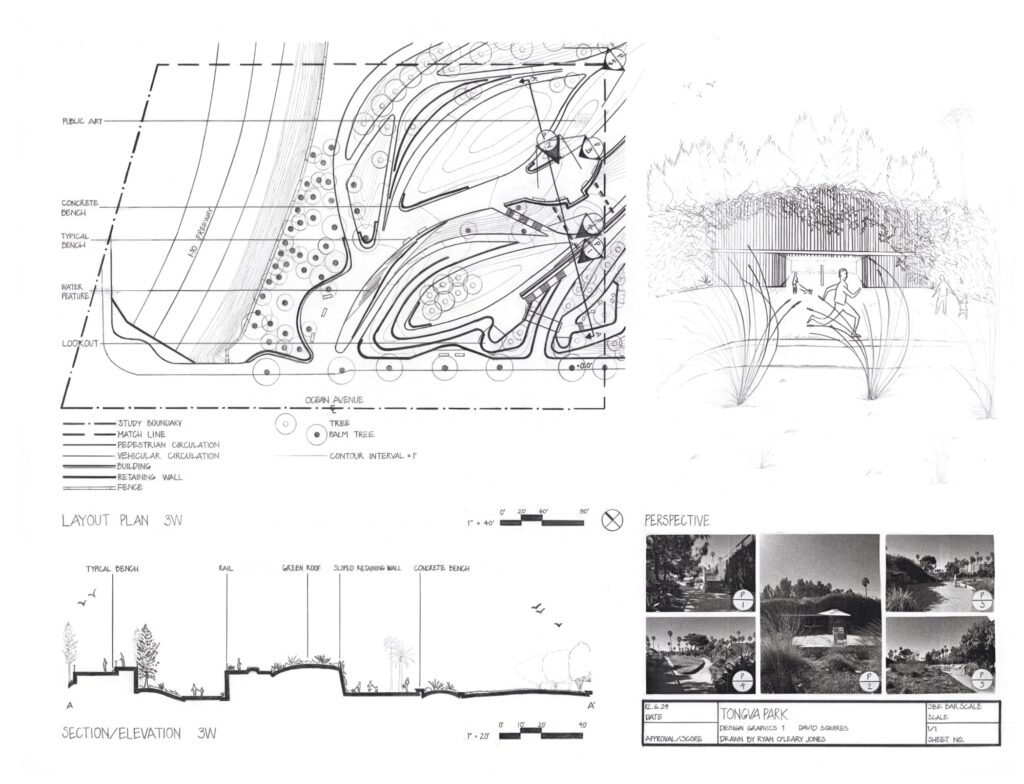
Tongva Park: Quadrant 3N
Student: Ryan O’Leary Jones
This project involved the detailed hand drafting of Quadrant 3W of Tongva Park, integrating technical precision with observational documentation. The work included a scaled plan drawing, a hand-rendered perspective, and a section elevation, each developed through direct site analysis. Supporting site photographs were taken, labeled, and keyed to the quadrant plan to connect graphic representation with real-world context. The project emphasized accurate scale, line weight quality, and clear communication of spatial relationships through traditional drafting techniques.
View PDF